
Questions People Ask Us
Why Does Rural America Lack Cold Storage and Food Distribution Infrastructure
People often ask us what Warehouses4Good does. Sometimes the question is part of a grant application, or it comes from a community leader, a farmer, or a logistics professional curious about our work.
Many of the questions center around a simple issue: why rural communities lack the infrastructure needed to move food through the supply chain.
In this post, we’re answering a few of the most common questions we receive.
What problem are we trying to solve?
Warehouses4Good works with local partners to develop food storage, processing, and distribution facilities that they will own and operate. We prioritize working with grassroots organizations in rural communities experiencing persistent poverty.
Our partners plan these facilities to support the full movement of food through the supply chain, from local producers to processors, distributors, and ultimately to the communities they serve.
Our partners lead the vision for these projects. They determine the scope, scale, and programming of their facilities based on local needs and opportunities. Our role is to help them organize, plan, design, fund, and build the infrastructure needed to make those facilities possible.
Together, our shared goal is to strengthen local food systems by:
increasing access to healthy food
improving community nutrition and health
creating economic opportunity for farmers, food entrepreneurs, wholesalers, and retailers
Why is food access harder in rural communities?
People often frame food access challenges in rural America as a production problem. In reality, the problem is largely a logistics problem.
Most food moves through a supply chain that relies heavily on cold storage, processing facilities, and distribution centers. These assets allow communities to safely store and transport food to markets. However, these facilities are concentrated near urban population centers.
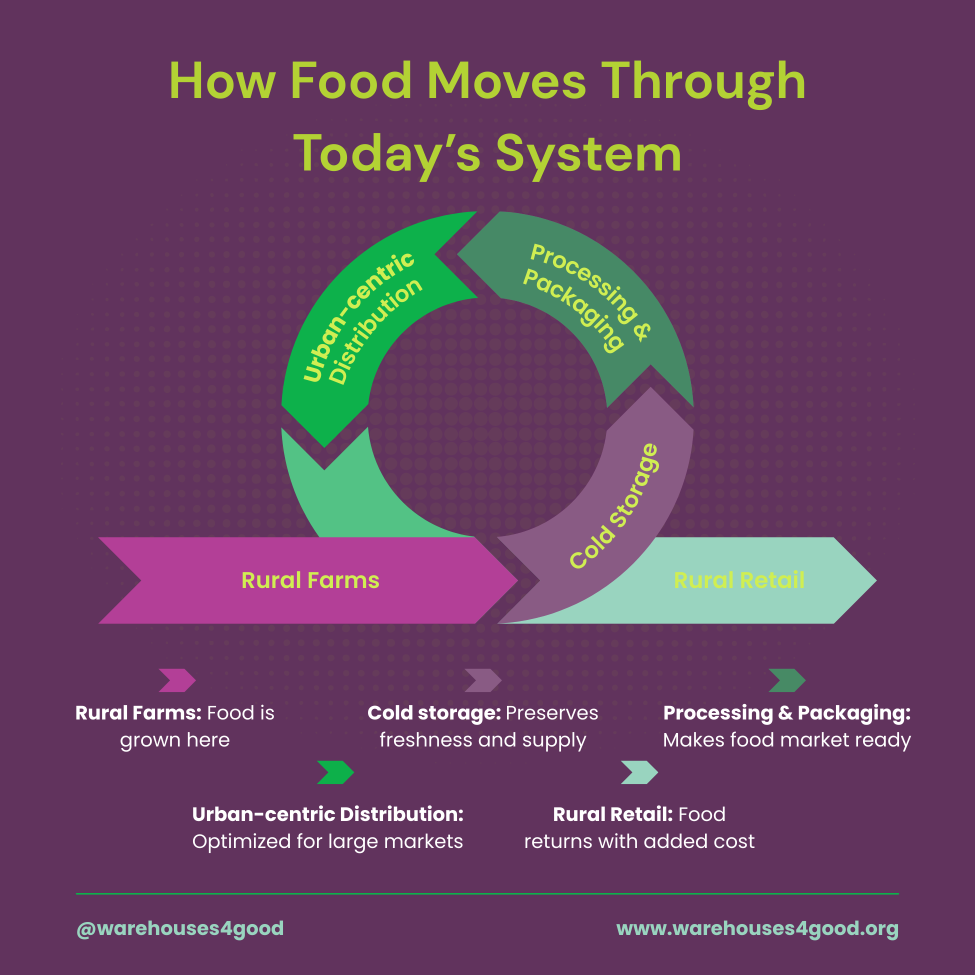
Figure 1: How food moves through our current, urban-centric system
Today, 94% of merchant cold storage capacity in the United States is in urban areas. Rural facilities that do exist are often specialized for large-scale commodity production, such as meat processing in the Midwest or fruit storage in Washington state.
This geographic imbalance creates a major barrier for rural producers and communities. For many food products, cold chain access is essential, roughly 70% of the food we eat requires temperature-controlled storage at some point in the supply chain.
For small and mid-sized farms, access to cold storage is especially important. Without nearby refrigeration and aggregation facilities, many producers cannot safely store perishable products long enough to negotiate sales and ship to regional markets.
The result is a structural gap in rural food systems. Communities may have agricultural production, but lack the infrastructure needed to safely store, process, and distribute that food locally or regionally.
Which communities does Warehouses4Good focus on?
The United States has 3,143 counties, and USDA classifies nearly 2,000 of them as rural. Among those rural counties, 267 counties across 31 states are identified as experiencing persistent poverty, meaning at least 20% of residents have lived below the poverty line for the past 30 years.
Warehouses4Good prioritizes work in 196 of these counties, particularly those located far from existing food distribution infrastructure. These counties are home to approximately 4.7 million people, including an estimated 900,000 residents experiencing food insecurity, among them roughly 300,000 children.
How does Warehouses4Good work with local partners?
Warehouses4Good takes a community-led approach to infrastructure development. Rather than imposing a standardized model, we partner with organizations that have already begun grassroots efforts to strengthen their local food systems.
These partners determine the size, functions, and programming of the facilities they want to develop. Our role is to support the process through technical assistance.
This includes:
project planning and feasibility support
engineering, design, and construction guidance
project management and cost engineering
Whenever possible, projects prioritize local architects, engineers, contractors, and trades, ensuring that the development process itself contributes to local economic activity.
Why does food infrastructure matter for rural communities?
Food infrastructure is the gateway to a functioning regional food system. When communities gain control over the infrastructure needed to store and move food, they can strengthen both food access and local economic opportunity.
For many regions, particularly Indigenous communities and persistent poverty areas, this infrastructure is also central to achieving food sovereignty, allowing communities greater control over how food is produced, distributed, and consumed locally.
_______________________________________________________________________________________________________
Interested in developing food infrastructure in your community? Start the conversation.
_______________________________________________________________________________________________________
References
This article draws on publicly available data and industry research to describe the current state of rural food systems and infrastructure in the United States.
USDA Economic Research Service: Rural classifications, persistent poverty county designations, and demographic data.
U.S. Census Bureau: County population data and national county totals.
Feeding America: Food insecurity estimates, including the Map the Meal Gap study.
Global Cold Chain Alliance: Industry insights on cold storage infrastructure and distribution patterns.
International Association of Refrigerated Warehouses: Data and research on refrigerated warehousing and supply chain infrastructure.